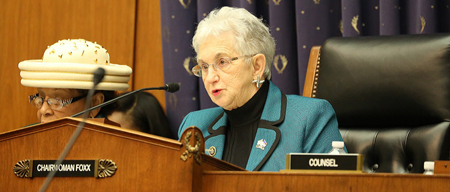
The House Oversight Committee will soon begin markup of H.R. 899, the “Unfunded Mandates Information and Transparency Act of 2013.” Representative Virginia Foxx (R-NC) originally introduced the bill in 2011 (then as H.R. 373). The American Action Forum (AAF) originally reviewed the bill here. The current iteration is substantively similar to the version from the 112th Congress. In addition, it maintains a bipartisan set of cosponsors. Read more »
“We have sought to recalibrate the federal role, undoing the excesses of the past,” said Kline, whose bill is supported by the National School Boards Association. Several Republicans said they would have liked to delete the federal government’s involvement altogether. “Many of my Republican colleagues and I feel the federal government should be out of education,” said Rep. Virginia Foxx (R-N.C.), adding that the bill was “a step in the right direction.” Read more »
Congresswoman Virginia Foxx (R-NC5), who co-sponsored the legislation, said “North Carolina teachers, parents and administrators – not Washington bureaucrats – should be in charge of making education decisions in our state. The Student Success Act I cosponsored centers around the theme of empowering the people closest to students with the authority to make education choices in their respective states and communities. By scaling back Washington’s one-size-fits-all micromanagement of classrooms, this legislation takes positive steps toward ensuring local educators have the flexibility required to meet the diverse needs of their students." Read more »
“I have the attitude that there is no role for the federal government in education. If I had my way about it, we would have gone a lot further with this legislation,” said North Carolina Representative Virginia Foxx. Read more »
“As a grandmother, educator and former school board member, I know students are best served when those at the local level are the driving force behind improving education. Washington red tape, duplicative programs and coercive standards compound the negative effects of flawed federal education laws on American schools. I will not allow Washington policy to compromise education quality, and the Student Success Act begins the process of getting Washington out of the way.” Read more »
Rep. Virginia Foxx, R-N.C., said many would like to eliminate the federal government's role in education, but the bill was "a reasonable first step in empowering the people closest to the students to make decisions for those students." Control from Washington has not brought educational improvements, she said. Read more »
"These waivers are a short-term fix to a long-term problem and leave states and districts with uncertainty about whether they will again be subject to the failing law, and if the administration will change the requirements necessary to receive a waiver," Rep. Virginia Foxx (R-N.C.) said. Read more »
But Rep. Virginia Foxx, R-N.C., a senior member of the education committee, is fully on board, even though the bill doesn't go as far as she would like. In a perfect world, Foxx said, the feds wouldn't have a role in K-12. But she thinks this bill is a major improvement over NCLB. "I can't understand why some people would just say no," she said in an interview. "They let the perfect be the enemy of the good." Read more »
“This is not a perfect bill, and the chairman admits that. I think most everybody does,” said Rep. Virginia Foxx (R-N.C.), vice chair of the Rules Committee, as debate began on Wednesday. “Everybody’s heard me say: If I had my way about it, the federal government wouldn’t be involved in education in any fashion.” Still, she said, the bill is a move in the right direction. Read more »